
Software Validation
Manage continuous software updates with AI assistance, while staying audit-ready.
For decades, application programming interfaces have been the foundation of enterprise integration. APIs let one software system request data or trigger an action in another. They connect an ERP system to a warehouse, a clinical platform to an analytics environment, a quality management system to a validation platform. Modern life sciences operations could not function without them.
But APIs were built for developers connecting known systems in predictable ways. An API assumes someone has already decided which endpoint to call, what data to send, what sequence to follow, and how to interpret the response.
AI agents don't work that way. An agent may need to figure out which system holds the relevant information, which available capability can complete the task, how to gather context from several sources at once, and how to adjust its approach based on what it finds along the way. Wiring that kind of reasoning into a fixed API contract, one custom integration at a time, is what the Model Context Protocol — MCP — is designed to solve.
MCP is an open standard for connecting AI applications to external data, tools, and workflows. It gives an AI application a consistent way to discover what capabilities are available, understand how to use them, and invoke them when appropriate. The MCP documentation compares it to USB-C for AI: one standardized interface through which many different applications can connect to many different systems.
For life sciences organizations, MCP is more than another integration technology. It can become the connective tissue of the agentic GxP ecosystem — provided it is built inside the same governance discipline that already applies to every other validated system.
An API is a defined interface that lets one application communicate with another. The API defines the available operations, the expected inputs, the authentication required, and the shape of the response.
This works well when the interaction is known in advance. A developer writes code instructing System A to call a specific endpoint in System B, the integration follows a predetermined path, and the response is handled by logic written specifically for that connection. APIs are excellent building blocks for reliable, deterministic system-to-system integration.
What they don't do is explain themselves to an AI agent. An API doesn't tell a model which endpoint to select, when to use it, what business context matters, or how a single action fits into a larger workflow. A developer has to build that orchestration by hand, for every system, for every use case.
MCP standardizes the interface between an AI application and the systems it needs to read from or act on. An MCP server can expose three kinds of capability:
Tools, which are actions the AI can invoke;
Resources, which are information the AI can read; and
Prompts, which are reusable instructions that help the AI perform a specialized task consistently.
These three primitives — tools, resources, and prompts — are defined directly in the MCP specification.
The AI application connects through an MCP client, which can discover what a server offers, read the schema and description for each tool, and select the appropriate capability based on the user's request and the context at hand.
That discovery step is the real difference from a conventional API integration. With an API, a developer decides in advance what will happen. With MCP, the developer still defines the permitted capabilities and the boundaries around them — but the AI decides, at runtime, which approved capability to use.
The easiest way to misread MCP is to treat it as an API replacement. It isn't. In most implementations, an MCP tool ultimately calls an existing API — the API still performs the underlying transaction. MCP adds an AI-native layer on top: it describes the capability, makes it discoverable, standardizes how it's invoked, and hands the result back to the AI application in a consistent form.
The API provides the connection. MCP provides the context and interface an agent needs to use that connection.
This distinction matters more as organizations adopt multiple models and AI platforms rather than standardizing on one. MCP already has broad ecosystem support — Claude, ChatGPT, Visual Studio Code, Cursor, and other AI clients all speak it, and can connect directly to remote MCP servers, discover their tools, and make approved tool calls through them.
Instead of building a custom integration for every model-and-system combination, an organization can expose a governed capability once, through an MCP server, and make it available to every authorized AI application that needs it.
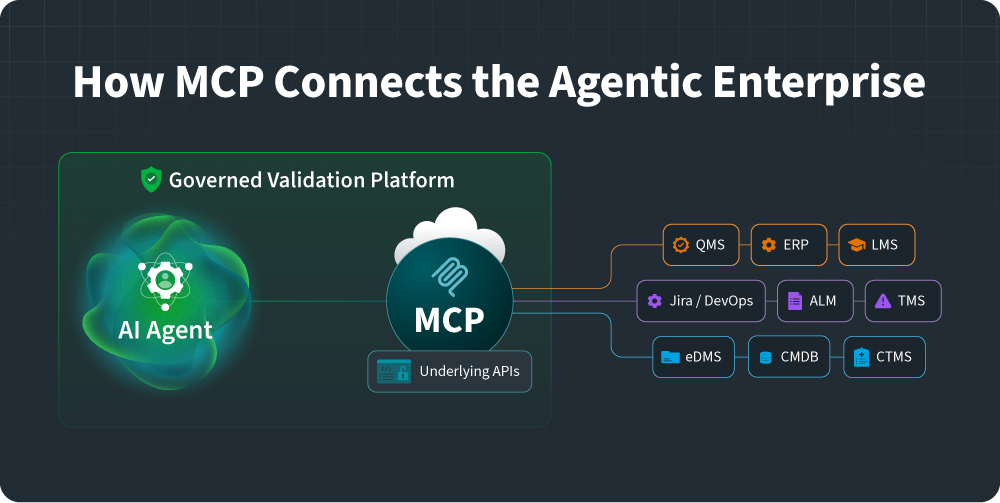
Picture a typical life sciences technology environment: a quality management system, a requirements or application lifecycle platform, Jira or Azure DevOps, a test automation tool, a document repository, a configuration management database, a learning management system, several regulated SaaS applications, and more than one AI model or assistant in use across the organization.
Built the traditional way, nearly every use case needs its own workflow. One integration retrieves a release note. Another creates a change request. Another collects test evidence. Another analyzes a deviation. Another updates traceability. Each one carries its own custom orchestration logic dictating which APIs to call and in what order, and adding a new model or agent to the mix means new development, a new security review, and new testing for every workflow that model touches. Connect even a handful of applications to a handful of systems this way and the integration count grows fast.
MCP replaces that sprawl with a reusable capability layer. Rather than coding every possible sequence in advance, the organization makes authorized tools and resources discoverable, and an agent selects among them while the surrounding platform enforces workflow, permissions, and approval boundaries. Enterprise systems keep exposing APIs; MCP servers translate the approved capabilities of those systems into something an agent can understand; agents reason across what's available; and a governed platform controls the records, decisions, approvals, and evidence that result. That layered architecture is what it takes to move from isolated AI assistants to enterprise agents that can participate in an actual business process.
Validation depends on information scattered across many systems. Today, people gather most of this by hand. Even where APIs already exist, they tend to support individual transactions rather than the reasoning process that connects them.
MCP can put that broader ecosystem within reach of a governed validation agent, in a few concrete ways.
APIs aren't going anywhere. They will keep providing the secure, reliable transactions that connect enterprise systems. But APIs alone were never designed for a world where intelligent agents dynamically discover capabilities, gather context, select tools, and orchestrate work across an enterprise — and MCP is the interface built for exactly that.
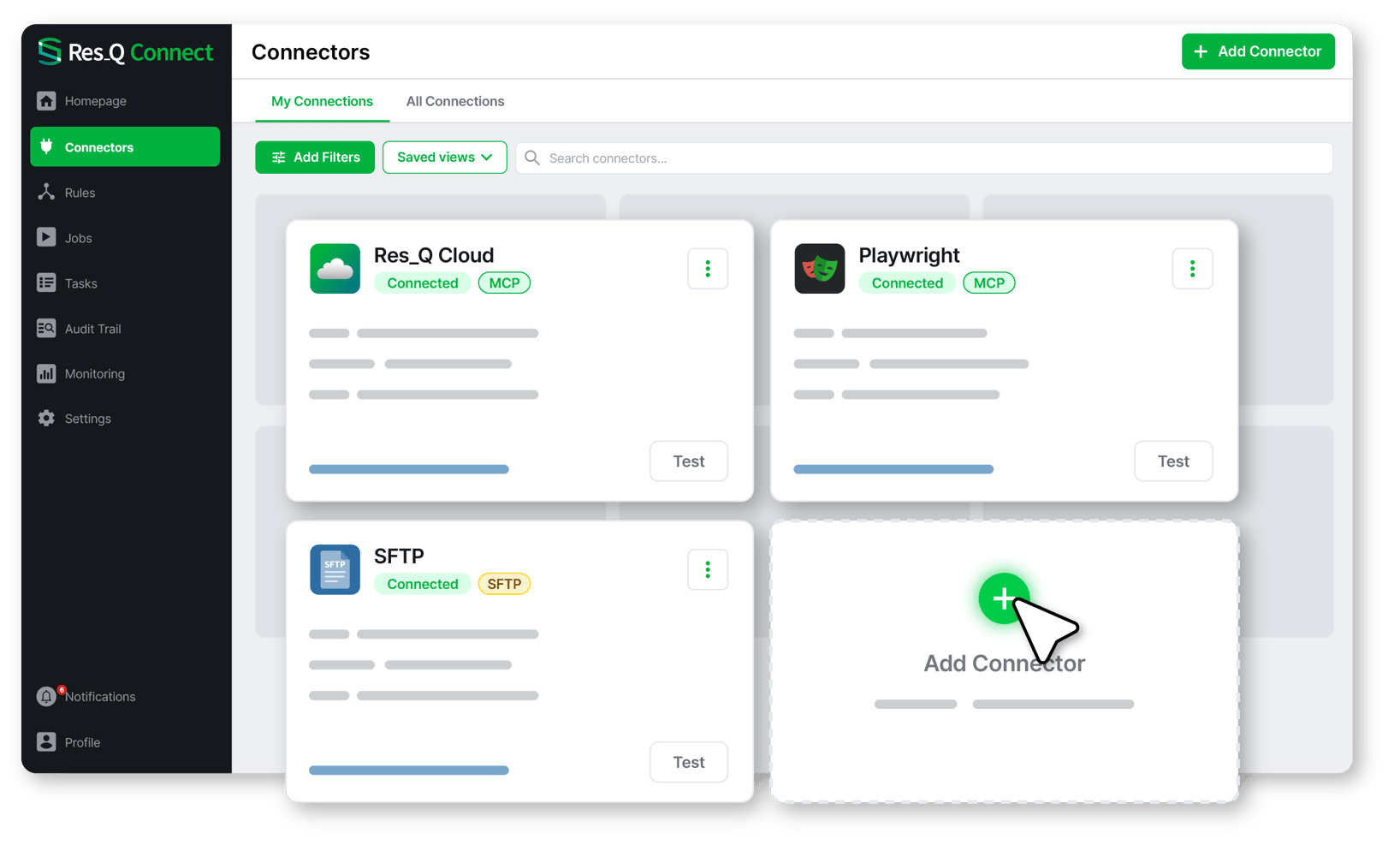
For GxP validation, the strongest architecture combines APIs for dependable system transactions, MCP for standardized agent access to tools and context, AI models for reasoning and interpretation, and a governed platform like Res_Q for the validation data, workflows, traceability, evidence, approvals, audit trails, and human oversight that make the result defensible.
MCP can help validation agents reach across the technology ecosystem. A governed validation platform can make sure what they do stays controlled. APIs connected the systems. MCP will connect the intelligence. A governed validation platform will make the result trustworthy.