Contents:
Key Takeaways
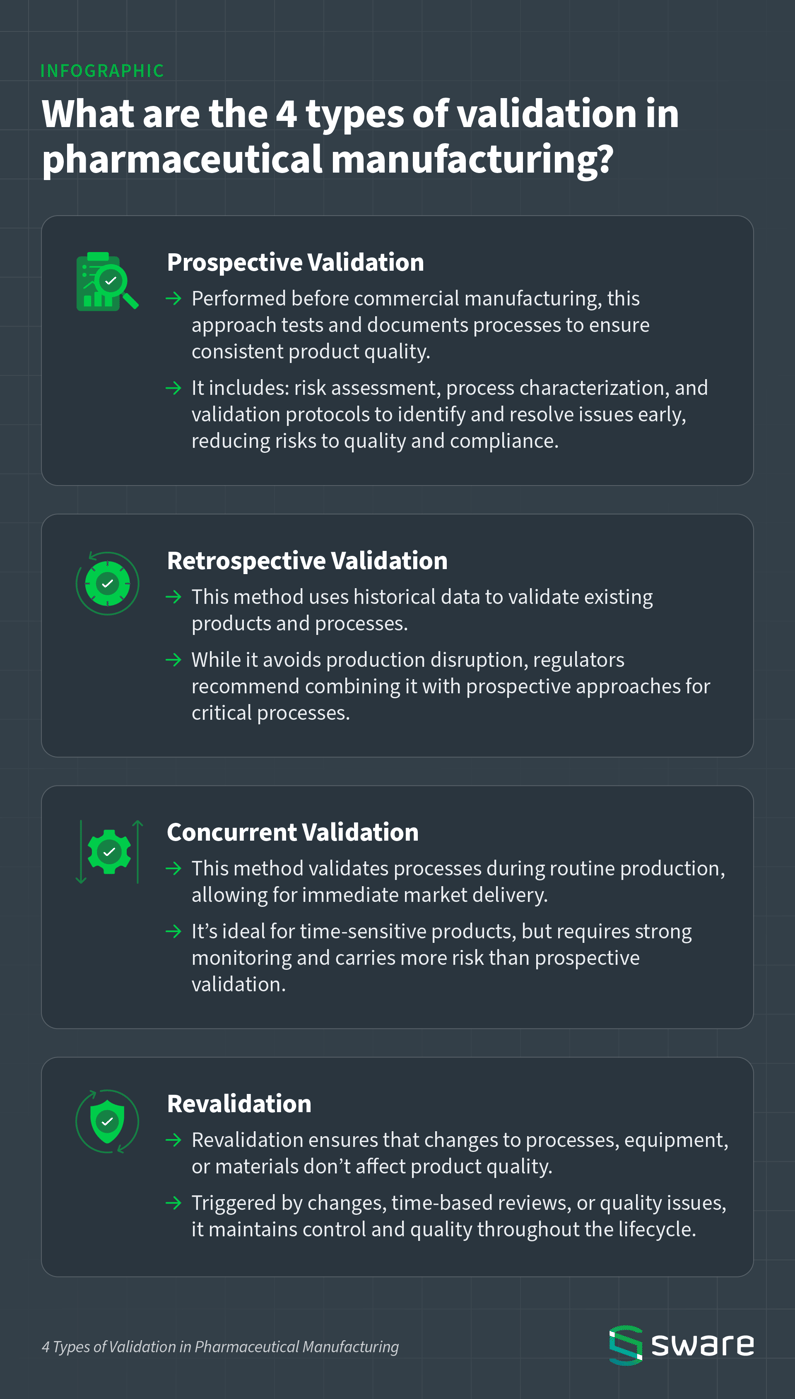
- Prospective Validation: Employed before manufacturing to test new products and processes, ensuring consistent quality.
- Retrospective Validation: Uses historical data to validate established processes without disrupting production.
- Concurrent Validation: Ideal for time-sensitive products, used to validate processes during routine production.
- Revalidation: Ongoing validation after changes to maintain product quality and process control.
Each of the 4 types of validation in pharma maps to a specific moment in the product or process lifecycle. Choosing correctly is not optional: it is a regulatory requirement with direct implications for compliance posture, audit readiness, and time-to-market.
What Are the 4 Types of Validation in Pharma?
Not all validation happens at the same stage, and the FDA is explicit about it. The 2011 Process Validation Guidance organizes the entire validation lifecycle into three stages: Process Design, Process Qualification, and Continued Process Verification. ICH Q10 reinforces this model as the industry standard.
Within those three stages, four distinct validation types define exactly when and how evidence is gathered. Each one applies at a different stage and carries a different risk profile, regulatory expectation, and documentation burden.
1. Prospective Validation
Prospective validation is performed before commercial production begins and is the foundation of every new product launch. It cannot be bypassed or replaced by concurrent or retrospective validation unless a documented regulatory exception applies. It is the default (and preferred) approach required by the FDA and EMA for all new products and manufacturing processes.
What you need to know
- When are validation protocols approved? Validation protocols are authored, reviewed, and approved before execution.
- What are the core qualification activities in prospective validation? IQ (Installation Qualification), OQ (Operational Qualification), and PQ (Performance Qualification) are executed in sequence before any product enters the market.
- When is the Validation Summary Report issued? An approved Validation Summary Report needs to be signed off by Quality before the first commercial batch release.
- How long does prospective validation take? Complex processes typically require 3–6 months to complete prospective validation end-to-end.
- What is the risk level of prospective validation? It carries a low risk level since deviations are identified and resolved before patient exposure.
2. Concurrent Validation
Concurrent validation is performed during routine production. Validation data is collected and reviewed in real time, so the product is manufactured and potentially released while validation is still underway. It demands tighter monitoring and faster decision-making than prospective validation.
What you need to know
- When is concurrent validation accepted? It is accepted under specific, documented circumstances: limited-batch products, orphan drugs, short shelf-life products, or situations where prospective validation is not feasible.
- What does the FDA require before concurrent validation begins? The FDA requires a risk assessment and a formal rationale documented in the validation plan before production begins.
- What is the risk level of concurrent validation? It carries a medium-to-high risk level, as non-conforming batches may already be in the distribution pipeline by the time issues are identified.
- What must teams have in place to run concurrent validation safely? Teams must have immediate CAPA protocols in place and real-time data visibility to respond quickly to acceptance criteria exceedances.
3. Retrospective Validation
Retrospective validation uses historical production data to demonstrate that a process has been in a state of control over time. It relies on accumulated batch records, trend data, and quality records. Teams that use it should assess whether current data quality and completeness are sufficient to withstand that scrutiny.
What you need to know
- What is the regulatory standing of retrospective validation today? Regulatory acceptance is low under modern guidance. The FDA's 2011 Process Validation Guidance and EU GMP Annex 15 have largely phased this approach out in favor of the lifecycle model.
- Where does retrospective validation still appear? It still applies in legacy processes operating before the current guidance took effect, and in some CSV scenarios for existing systems.
- How much historical data is needed for retrospective validation? A minimum of 10–30 historical batch records is typically required to demonstrate statistical consistency, per industry best practice.
- Can retrospective validation be used for new processes? Retrospective validation is not acceptable for new products or new processes. If a process is new, prospective validation is required.
4. Revalidation
Revalidation reconfirms that a previously validated process still performs within its established parameters. It is triggered by change or time, not a one-time event. Teams that treat revalidation as a reactive one-off exercise consistently face audit findings and compliance gaps.
What you need to know
- What triggers change-driven revalidation? Change-triggered revalidation is required when modifications could affect product quality: equipment upgrades, facility moves, formulation changes, supplier changes, or regulatory updates.
- When does periodic revalidation occur? Periodic revalidation occurs as part of Continued Process Verification (CPV) programs, even in the absence of a specific change.
- Why is revalidation easy to miss? Change-triggered revalidation is one of the most resource-intensive activities for pharma quality teams, and it can be easy to miss without a formal change control process.
- What role does change control play in revalidation? A robust change control process identifies when a change has sufficient impact to trigger revalidation and routes it to the appropriate team.
Summary Validation Timing Matrix
Check the details for each type of validation, from when it applies, risk level, and what to expect from regulators:
| Type |
When Applied |
Regulatory Acceptance |
Risk Level |
Typical Duration |
| Prospective |
Before production launch |
High (preferred by FDA/EMA) |
Low (managed upfront) |
3 to 6 months |
| Concurrent |
During production |
Conditional (requires justification) |
Medium–High |
Ongoing per batch |
| Retrospective |
After production (from historical data) |
Low (largely phased out) |
High if misapplied |
Varies |
| Revalidation |
After changes or periodically |
Required (change-triggered) |
Medium |
Scope-dependent |
Mobile users: scroll to the right to see the full table.
Common Mistakes Teams Make
Even experienced validation teams can fall into predictable traps when managing multiple validation types simultaneously.
- Treating revalidation as a one-time event. Revalidation is a continuous program, not a project. Teams that only revalidate when a major change is flagged (and ignore periodic CPV requirements) accumulate undocumented drift risk that surfaces during audits.
- Applying retrospective validation to new processes. This is a regulatory non-starter. New processes require prospective validation. Using historical data as a proxy will not withstand inspection.
- Missing the change control + revalidation link. Revalidation is only as reliable as the change control system that triggers it. Without a formal process that evaluates every change for validation impact, revalidation gaps are inevitable.
See: GxP Change Management.
- Approving batches before full concurrent validation data review. Concurrent validation requires real-time data review — not post-hoc batch record analysis. Releasing the product before the acceptance criteria are confirmed eliminates the protection that concurrent validation is designed to provide.
For a broader view of data integrity requirements that underpin all 4 types, see our FDA Data Integrity Audit Checklist.
From Challenge to Compliance: A Biopharma Case Study
A leading biopharmaceutical company developing cancer and infectious disease treatments was managing 25–30 software system releases per year. As their validated system portfolio scaled, legacy validation processes created bottlenecks across all validation types, delaying releases and increasing compliance risk.
After implementing Sware's Res_Q platform:
- ~102 FTE hours saved per validation project
- All paper-based processes eliminated with an end-to-end paperless ecosystem
- Centralized visibility across all validation activities and system states
- Continuous audit-readiness maintained without pre-inspection scrambles
As their Director of Clinical and Development Systems stated: "Sware provides both the platform and the people needed to excel, saving us time and money and making our lives considerably easier."
How Digital Platforms Support All 4 Validation Types
Managing 4 distinct validation types from disconnected systems through spreadsheets, shared drives, and email approvals is operationally unsustainable at scale.
Purpose-built validation platforms eliminate fragmentation by providing a single source of truth for every validation type, with workflows tailored to each one.
How can one platform manage the four validation types?
- Prospective: Pre-built protocol templates and automated IQ/OQ/PQ workflows reduce authoring time. Requirements traceability matrices auto-populate as test cases are linked.
- Concurrent: Real-time dashboards surface batch data against acceptance criteria as production runs, not hours later. Teams can act immediately when data trends outside parameters.
- Retrospective (legacy support): Centralized document repositories consolidate historical batch records into structured, searchable formats, which makes retrospective data review faster and more defensible.
- Revalidation: Automated change control workflows flag when a system or process change requires revalidation, route it to the right team, and create a documented approval trail.
To understand the full cost of unmanaged validation across these 4 types, read our validation Debt e-book.
Organizations using integrated validation platforms report 40–60% reductions in validation cycle times compared to paper-based approaches while maintaining full data integrity and audit trail compliance.
See also: Digital Validation Strategy | Paperless Validation.
Frequently Asked Questions