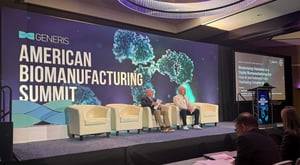
A recap of Modernizing Validation in a Digital Biomanufacturing Era: How AI and Automation are Reshaping Compliance from the 2026 Generis American Biomanufacturing Summit
-
Bryan Ennis, Co-Founder & Chief Quality Officer at Sware
-
Jeff Brittain, former Head of IT at North America, Bayer, and current Executive in Residence at FedEx Institute of Technology, President of Verix Partners, and CEO of P3ARL Technologies
At this year's Generis American Biomanufacturing Summit, we sat down for what we called a "fireside chat" — a series of deliberately provocative statements about the state of validation in life sciences, followed by an honest conversation about where things need to go. The room was full, the coffee was hot, and the topic hit a nerve.
Here's what we walked away with.
The validation process was designed for a world that no longer exists
Validation has always had noble goals: proving systems work, proving they were installed correctly, and demonstrating change control throughout a lifecycle. But the process was architected 30 years ago for paper-based workflows and systems that changed once every three years. That world is gone.
Consider the pace of change today. Apple has pushed five iOS updates in just the first four months of this year alone. Cloud-based SaaS vendors are releasing changes dozens of times per month. And now, with AI systems that continuously evolve through model updates, algorithm shifts, and data drift, the old paradigm of periodic, document-heavy validation simply cannot keep up.
The uncomfortable truth many of us are living with: a surprising number of large life sciences organizations are 12 to 18 months behind on compliance for their SaaS systems right now. That gap is somewhat tolerable when it involves a well-known, widely-trusted platform. It becomes a serious liability when it involves a novel AI application without that same industry trust..
Regulators are moving faster than we think
Here's a statement neither of us expected to make: the FDA may actually be ahead of many of our own organizations on this. Off the record, the agency has undergone enormous internal change over the last year. The shift from CSV to CSA and beyond reflects a genuine evolution in thinking. And we're seeing real alignment — the EMA and FDA published joint expectations for AI systems this year, and the FDA's credibility assessment framework for AI-based decision-making is already being put into practice.
The regulatory signals are clear: authorities want us to do this better, not kill innovation with paper. They're encouraging critical thinking, risk-based approaches, and openness to new digital tools.
But here's the key takeaway — the biggest barrier to progress often isn't the agency. It's our own internal quality cultures, our own SOPs, and our own institutional inertia.
Your validation toolkit wasn't built for AI
Our standard templates, test scripts, and methodologies adapted reasonably well to the cloud. We learned to verify that vendors had our infrastructure configured correctly, and we kept validating with familiar frameworks. That approach breaks down with AI for several reasons.
Development is fundamentally different
Agentic coding and tools like Claude Code mean that software is increasingly built through iterative conversations rather than traditional requirements-to-dev-to-test pipelines. Requirements become emergent — you build something, evaluate it, and document it after the fact. That inverts the entire validation paradigm.
AI systems are probabilistic, not deterministic
We can no longer just confirm that a button works or doesn't. We're now in the territory of statistical process control — demonstrating that outputs stay within acceptable ranges based on scientific principles. The shift moves us from "proving it works" to "demonstrating it works," and from reactive validation to proactive and even predictive assurance.
The speed of AI decisions outpaces traditional oversight
When agentic systems are making hundreds or thousands of decisions per second, you can’t validate each one. You need frameworks for continuous monitoring, not point-in-time testing.
The good news is that the regulatory guidance actually supports this evolution. Frameworks like GAMP 5 Second Edition, the ISPE AI GPG, and the FDA’s credibility assessment all provide the intellectual scaffolding. What we need now are better processes designed around them.
Validation has a talent crisis — but so does everyone else
The days of a distinct validation department running a linear, documentation-heavy process are numbered. When a capability becomes as ubiquitous as AI, everyone in the organization needs to understand it — and everyone needs to own a piece of validation.
We’re big believers in upskilling. The people who understand validation today aren't going away; their roles are evolving. The shift is from critical analytical thinking with a documentation mindset to critical thinking about how technological systems operate and how data demonstrates their performance.
Think about managing AI systems the way you manage people. You define a job description, you verify qualifications, you train, you monitor performance, you course-correct — and sometimes you "decommission." The mental model transfers surprisingly well.
The best biomanufacturing companies will be run by the validation function
We debated this one on stage. One of us argued the best companies in 3–5 years won't have a validation department. The other countered that the best companies will be run by the validation department. We landed closer to the latter.
What we're seeing is a replay of the lean manufacturing revolution of the late '80s and early '90s — separate tasks and siloed automation giving way to holistic, team-based systems. Validation, in this context, becomes the connective tissue. Not a backstop or a compliance checkbox, but the strategic function that provides assurance to leadership that systems, agents, and processes are operating as they should.
Software vendors are investing in connectivity layers (MCP, APIs, automated evidence generation). Validation evidence will increasingly come directly from the systems themselves. The role shifts from project-based testing to ongoing data stewardship — watching, monitoring, and ensuring continuous compliance.
And as companies begin vibe-coding their own internal applications instead of paying for massive ERP upgrades, the question of "who makes sure this works?" lands squarely on the validation function. You can't lean on SAP anymore. You have to lean on yourself.
What this means for partners and CDMOs
For technology vendors and service partners, the message is clear: the companies that win will be the ones that help redesign processes, not just sell tools. AI isn't a plug-in for an existing regulatory framework. It demands rethinking workflows from the ground up, and vendors who've done that transformation multiple times bring irreplaceable knowledge to the table.
For CDMOs, compliance and validation maturity is becoming a genuine competitive differentiator. The ability to support sponsors with data integrity, validated systems, and regulatory sophistication — that's how you win and retain business in this era.
The bottom line
Validation isn't going away. Quality assurance isn't going away. What's going away is the illusion that a paper-based, point-in-time, reactive process can keep pace with the systems we're building now. The organizations that recognize this — and invest in the culture, the talent, the tools, and the frameworks to evolve — will be the ones delivering safe, life-changing therapies faster than anyone thought possible.
The first step in any journey is acknowledging you have a problem. Consider this our collective step one.
This post is a summary of themes discussed at the 2026 Generis American Biomanufacturing Summit. Views expressed reflect the perspectives shared during the session by Bryan Ennis (Sware) and Jeff Brittain (former Bayer; FedEx Institute of Technology; Verix Partners Inc; P3ARL Technologies, Inc) .